
Auto Insurance by State: Which States Have the Highest (and Lowest) Rates
Average auto insurance premiums jumped 26% between 2022 and 2024, according to NAIC data—yet that national figure masks enormous gaps between states. A driver in Michigan might pay $6,000 annually while someone in Ohio covers the same vehicle profile at $1,200. Understanding these differences isn't just trivia; it's money in your pocket.
This data-driven breakdown pulls numbers directly from Bankrate's 2026 survey and III.org reports to show where premiums sit today, why they differ, and how you can legally restructure your policy to pay less. Let's dig into state-level comparisons that actually matter.
Why Premium Gaps Exist Nationwide
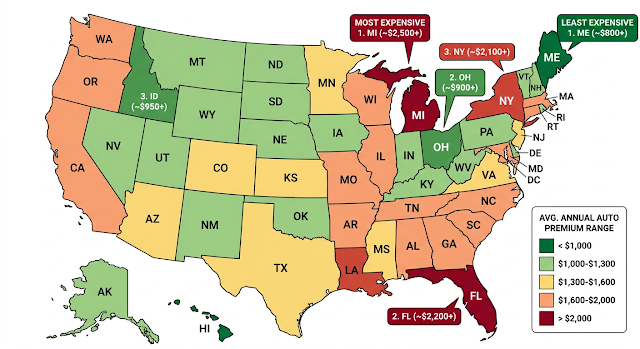
Ever wonder why your cousin in Vermont pays half what you do in Florida? State-level pricing differences come down to regulation, litigation climate, and local risk pools. Each state sets its own minimum liability requirements, fraud penalties, and insurer profit margins. No-fault states tend to cost more because personal injury protection (PIP) mandates inflate base premiums. According to the Insurance Information Institute (III.org), no-fault jurisdictions average 20-30% higher premiums than tort states.
Regulation and Filing Laws
States like California use a prior-approval system where regulators must sign off on rate changes before they take effect. This creates price stability but can delay adjustments. In contrast, "use-and-file" states allow insurers to implement rates immediately, leading to faster—and sometimes steeper—increases. The NAIC reports that states with stricter regulatory oversight tend to see slower premium growth year-over-year, though not necessarily lower absolute costs.
Litigation and Fraud Climate
Louisiana and Florida rank among teh most expensive states partly because of aggressive personal-injury litigation. Staged accidents, inflated medical claims, and attorney advertising drive up insurer loss ratios. These costs get passed directly to policyholders. J.D. Power's 2024 claims satisfaction study noted that states with high fraud incidence also had lower customer satisfaction scores—drivers pay more and get a worse experience.
Ten Most Expensive States (2024-2025 Data)
Based on Bankrate's 2026 full-coverage survey and NAIC expenditure reports, these states carry the heaviest premium burdens for a 35-year-old driver with clean history:
- Michigan — $6,109 average annual premium
- Louisiana — $4,406
- Florida — $4,232
- New York — $3,890
- Nevada — $3,571
- Delaware — $3,340
- Texas — $3,286
- Georgia — $3,155
- Kentucky — $3,048
- Maryland — $2,980
Michigan's Unique Cost Driver
Michigan's unlimited lifetime PIP benefits—reformed in 2020 but still expensive—keep it at the top. Even post-reform, drivers choosing uncapped medical coverage see premiums well above $5,000. Bottom line: Michigan's no-fault structure remains the single biggest outlier in U.S. auto insurance pricing.
Southern and Southeastern Trends
Louisiana, Florida, Georgia, and Texas share common threads: high uninsured-motorist rates (often 15-20% of drivers), severe weather exposure, and dense urban corridors. These factors compound each other, making the Southeast a persistently expensive region regardless of individual driving records.
Ten Cheapest States for Drivers
On the opposite end, these states consistently deliver lower premiums according to III.org expenditure data:
- Maine — $1,047 average annual premium
- Vermont — $1,091
- New Hampshire — $1,112
- Idaho — $1,178
- Ohio — $1,223
- Iowa — $1,260
- North Carolina — $1,301
- Virginia — $1,344
- Wisconsin — $1,356
- Utah — $1,389
New England's Low-Cost Advantage
Maine, Vermont, and New Hampshire benefit from low population density, minimal fraud, and conservative litigation environments. Rural roads mean fewer multi-vehicle collisions. New Hampshire doesn't even mandate liability coverage—though most drivers carry it voluntarily—creating a competitive marketplace that keeps rates low.
Midwest Stability Factors
Ohio, Iowa, and Wisconsin combine moderate regulation with low uninsured-motorist populations and fewer catastrophic weather events compared to Gulf Coast states. Insurers' loss ratios stay predictable, and those savings flow to consumers.
Rating Factors Beyond Driving Record
Your claims history matters, but insurers weigh several variables you might not expect. Here's what one insurer doesn't want you to know: credit score often influences your premium more than a single at-fault accident.
Credit-Based Insurance Scores
In 47 states (all except California, Hawaii, and Massachusetts), insurers legally use credit-based scores. NAIC data shows drivers with poor credit pay 40-100% more than those with excellent scores—even with identical driving histories. This single factor can swing a premium by $1,500 or more annually.
Zip Code and Garaging Address
Your exact zip code determines theft rates, vandalism frequency, and accident density. Moving ten miles—from an urban core to a suburban neighborhood—can drop your rate 10-15% without any coverage change. J.D. Power research confirms that geographic micro-rating has intensified since 2020 as insurers adopt telematics and geospatial data.
Using State Data to Negotiate
Armed with comparison data, you hold leverage during renewal conversations. Agents don't volunteer discounts—you have to ask.
Quote Shopping at Renewal
Bankrate recommends pulling at least five quotes every 12 months. Present competing offers to your current carrier and explicitly ask about loyalty credits, bundling adjustments, or mileage-based discounts. Drivers who shop annually save an average of $400 compared to auto-renewers, per III.org consumer surveys.
Adjusting Coverage Structure
If your state's minimum liability sits at 25/50/25, consider whether stepping up to 100/300/100 actually costs much more—in many affordable states, the jump adds only $15-$30 monthly. Conversely, in expensive states, raising your collision deductible from $500 to $1,000 saves 15-20% on that portion of your premium. Bottom line: restructuring beats switching carriers in many cases.
Minimum vs. Recommended Coverage Levels
State minimums exist to keep you street-legal, not to protect your finances. There's a massive gap between the two.
Legal Minimums by Region
Most states require 25/50/25 or 30/60/25 in bodily injury and property damage liability. A few—like Alaska and Maine—set higher floors at 50/100/25. These minimums haven't kept pace with medical costs or vehicle values, leaving drivers exposed to lawsuits exceeding their coverage limits.
Financial Protection Thresholds
III.org recommends at least 100/300/100 for drivers with assets exceeding $100,000. Adding an umbrella policy ($1 million extra liability) typically runs $150-$300 annually—remarkably affordable given the protection. In litigious states like Florida or New York, this isn't optional; it's essential.
FAQ: Changing Address to Save Money
Can you register your vehicle in a cheaper state to cut premiums? Technically, your policy must reflect where the car is primarily garaged. Registering in a state where you don't reside constitutes fraud—and insurers investigate aggressively after claims.
Legal Residency Requirements
Each state defines residency differently, but generally you must live there 183+ days per year. Military personnel and full-time students sometimes qualify for exceptions. If you legitimately relocate, you're entitled to that state's rates—but paper-only moves trigger policy cancellations and denied claims.
Legitimate Relocation Strategies
If you work remotely and genuinely move to a lower-cost state, update your license, registration, and policy simultaneously. Use free comparison tools like Policygenius or The Zebra to quote your new zip code before committing. A real move from Michigan to Ohio could save $3,000+ annually on identical coverage—entirely legal and straightforward.
Conclusion: Auto insurance premiums vary dramatically across states due to regulation, litigation, and local risk factors. Drivers who understand these differences—and actively shop, adjust deductibles, and carry appropriate coverage—consistently pay less without sacrificing protection. Use NAIC and III.org data as your baseline, quote multiple carriers annually, and never accept a renewal price without questioning it first.